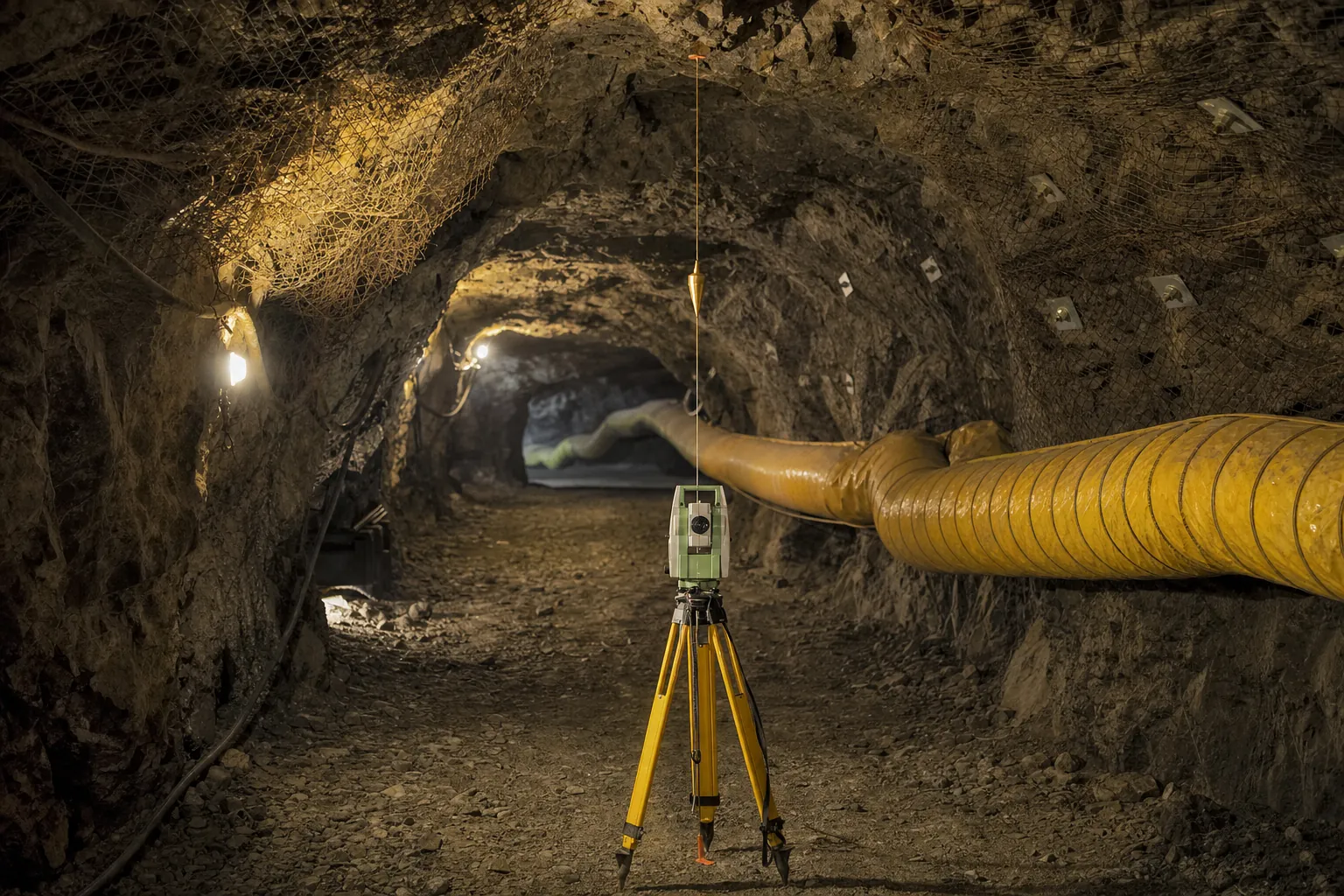
Underground survey control is what keeps an advancing decline pointing where the design says it should. On underground development, that control is carried forward station by station, and the further it goes, the more it depends on how it was checked along the way.
Quick Answer
Underground control is extended by traversing from known stations, back to a control connection carried down from surface. Each new station inherits the uncertainty of the ones before it, so the network should be tied back to a known point at intervals, not trusted indefinitely from one starting connection. Check stations again after any event that could have disturbed them, and record every check.
The connection at the shaft station itself is covered in our article on shaft survey control. This article starts where that one ends: past the station, into the workings.
How underground survey control is carried forward
Underground survey control is established and extended without satellite positioning, using traverse legs tied back to the connection that was carried down from surface.
That makes the network's reliability a matter of care rather than of method. A well-made connection and carefully observed legs give a dependable network. A rushed connection, or a leg that was not checked, passes its error to every station that follows. Underground survey is not inherently less accurate than surface work. It is less forgiving of a skipped check.
Where a portal or a large open stope gives a view of the sky, satellite positioning may still be usable for part of the network. Most underground workings have no such view, which is why traverse and the checks around it carry the whole network.
| Stage | What it adds | What it depends on |
|---|---|---|
| Shaft connection | The starting direction, position and level | Two separately checked transfers |
| Each traverse leg | A new station further into the workings | Every leg before it |
| Each tie-back | A check against a known point | A point that is still trustworthy |
| Each orientation check | An independent direction | A separate observation, such as a gyro |
Key point
Every new underground station inherits the history of the network behind it. The checks along the way are what make that history trustworthy.
A procedure for extending control
Extending control safely through ongoing development is a short procedure, repeated as the workings advance.
Start from a checked connection
Begin from a shaft connection, or a portal connection on a decline, where direction and position were each transferred and checked separately. Everything that follows inherits it. If the connection has not been checked, check it before extending anything from it.
Close the work where you can
A traverse that closes back on a known point shows how well it was observed. An open traverse can be internally consistent and still be wrong, because nothing tests it. Where the layout of the workings allows a loop, use it.
Tie back at intervals
Extending control deeper compounds the uncertainty from each earlier station. Plan tie-backs to known points as development advances, rather than carrying the network forward from one starting connection indefinitely. Agree the interval in advance with the mine's survey department, so tie-backs happen as part of the plan rather than after a problem is suspected.
Check direction independently
An independent orientation, such as a gyroscopic observation, can reveal whether a long traverse has drifted in bearing. Our article on what a gyro survey measures explains what that check does and does not settle.
Development far from the last tie-back?
Send us the control layout. We will suggest where to check back.
Ask us to review the networkKeeping stations trustworthy
A station is only as good as its last check, because underground stations can move without any visible sign.
Recheck stations at planned intervals and after any event that could have disturbed them: blasting nearby, ground movement or rehabilitation work. Record each check with the station, the date, the observer and the result. A station that has moved should be replaced or re-observed before anything else is set out from it, and the change should be recorded so earlier work set out from it can be reviewed.
Station protection matters as much as checking. Place stations where they are least likely to be disturbed by equipment, services or rehabilitation, and make sure every crew knows which stations are authoritative. Good underground survey control depends on stations that the people working around them know to protect. On long-running mines, records from different eras may sit on different systems, a problem covered in our article on underground mine coordinates.
Key point
Underground survey control is not set once. It is extended, tied back and rechecked for as long as the workings keep advancing.
Starting a new decline?
Tell us the development plan. We will plan the control and its checks with it.
Get an underground survey quoteWhere survey cannot help you
Careful underground survey control keeps the network dependable, but some problems sit outside what control can solve on its own.
Control cannot correct development already driven from a drifted network; it can only show how far the development has departed from design, so that the next decision is made on known positions. It cannot confirm a station that was disturbed after its last check, and it cannot tie back to a point that has been lost. Mine survey practice in the region has its own professional body, the Institute of Mine Surveyors of Southern Africa, and where a network is in doubt, an independent check can test it against known points.
Let's Build With Accuracy.
Underground control extended, tied back and rechecked as your development advances.
Request a Quote No obligation — we reply within one business day.