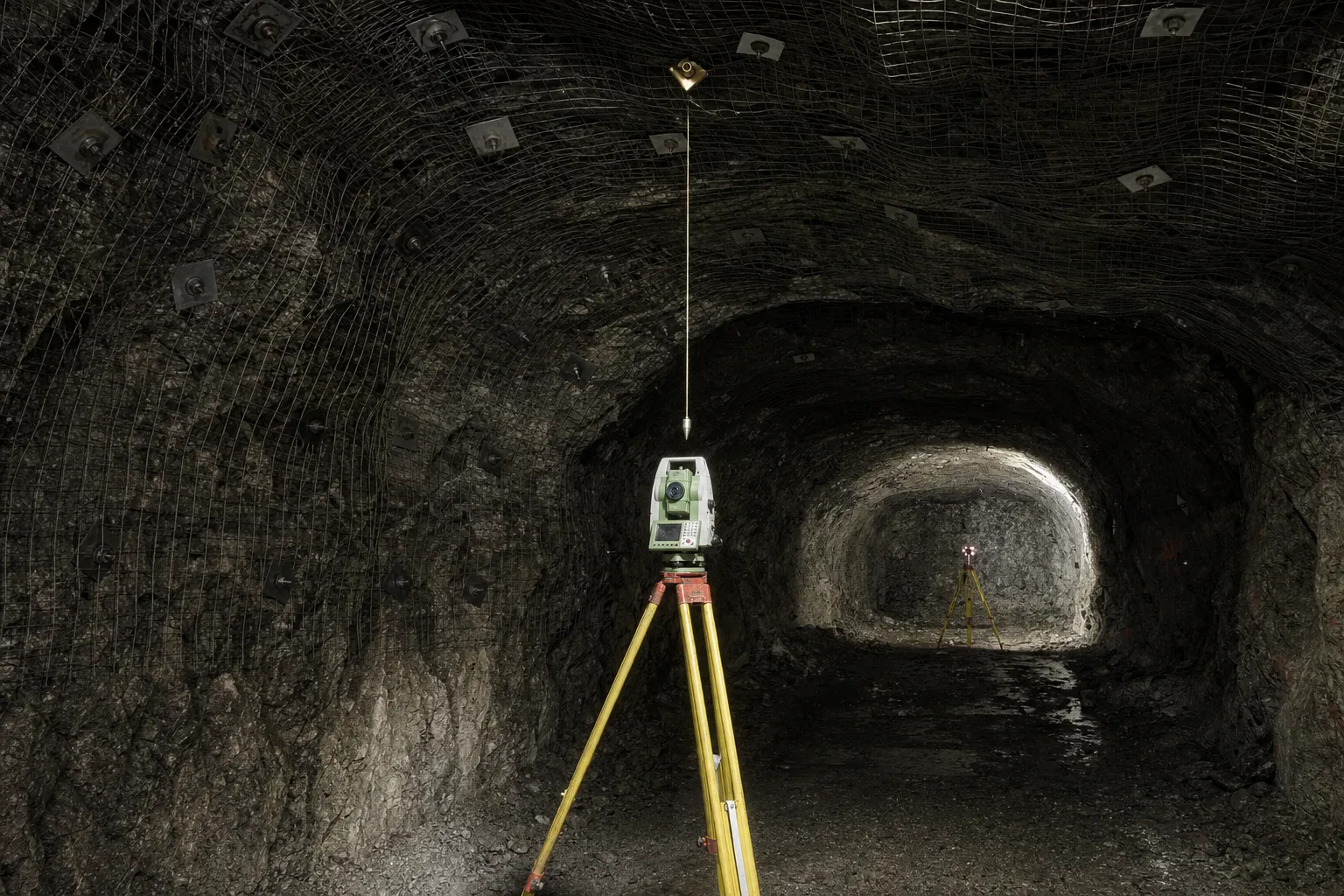
Underground survey closure is often read as the final word on whether the control is right. On underground mining surveys, a traverse that closes well is good news, but it answers a narrower question than most readers think.
Quick Answer
A closure, the small misclose found when a traverse loop returns to a known point, shows the observations are consistent with each other to within that misclose. It does not prove the traverse's absolute position or orientation, because a consistent systematic error closes just as well as no error at all. Confirm orientation and position separately, for example with a gyro observation and a tie to an independent known point.
How control is carried forward through the workings is covered in our article on underground survey control. This article is about reading the closure figure in the report.
What underground survey closure shows
A closed traverse starts and ends on known points, so the surveyor can compare where the observations say the last point is with where it is known to be.
The difference is the misclose. A small misclose shows that the angles and distances in the loop agree with each other well. That is useful. It catches random errors, a misread angle, a wrongly booked distance or a disturbed station, which would otherwise pass unnoticed. An open traverse, which does not return to a known point, has no closure at all, and so no internal check of this kind.
What it cannot show
Some errors affect every observation in the loop the same way. If the starting orientation is wrong, every bearing in the loop carries the same error, and the loop still closes. If an instrument has a constant error, it applies to every leg alike, and the loop still closes. The traverse is consistent with itself, and consistently wrong. Closure measures agreement, not truth.
Reading the closure in a report
When a report gives an underground survey closure figure, check three things. Which known points did the loop start and end on, and how were those points established? Was the loop closed on itself, returning to its own starting point, or connected between two different known points? And which stations were part of the loop, and which were extended from it afterwards? A loop that returns to its own start tests the observations but shares one starting orientation throughout. A traverse connected between two independently established points tests more, because the two ends were fixed separately.
Watch closure over time
One closure describes one loop on one day. On long-running development, keep the closure results for each loop in one register, with the date and the stations used. A gradual change in the underground survey closure from loop to loop can point to a disturbed station or a change in method before it becomes a problem at the face.
Key point
A good closure proves the observations agree with each other. It does not prove the network sits in the right place or points the right way.
A closure figure you are relying on?
Send us the traverse report. We will say what it does and does not establish.
Ask us to read the reportChecks that closure does not replace
Because closure tests only internal consistency, three further checks are needed to confirm that underground control is correct in orientation and position.
| Check | What it confirms | Why closure cannot |
|---|---|---|
| Independent orientation | The network points the right way | A wrong start bearing closes |
| Tie to a separate known point | The network sits in the right place | A shifted start point closes |
| Independent check by another team | The work holds up to fresh observations | Re-reading the same data repeats its errors |
Independent orientation
An orientation observed separately from the traverse, such as a gyroscopic observation, can show whether the network has turned. Our article on what a gyro survey measures explains what that check settles.
A tie to a separate known point
Where the layout allows, connect the traverse to a point established independently, for example through a second shaft or a separate connection from surface. Agreement with that point tests position in a way closure cannot.
An independent check
Where the work matters, such as before a breakthrough or a major development decision, the check should be made by a different surveyor or team using a fresh connection to control. Re-computing the same observations is a review of the arithmetic, not a check of the field work. Agree in advance who carries out that check, when it is due, and how its results will be compared with the original, so the check happens as part of the plan.
Where survey cannot help you
Closure and the checks above make underground control dependable, but some problems sit outside what any survey figure can settle on its own.
A survey cannot confirm a starting connection that was never checked, which is why the shaft connection on shaft sinking and equipping surveys needs its own verification. Each new station also inherits the uncertainty of the ones before it, so a closure on one loop says little about control extended far beyond it. Mine survey practice in the region has its own professional body, the Institute of Mine Surveyors of Southern Africa.
Key point
Read underground survey closure as a check of consistency. Confirm orientation and position with separate, independent checks.
Need underground control checked?
Tell us the layout and the connections. We will price an independent check.
Get an underground survey quoteControl in doubt?
An independent check can test it against points it was not built from.
See survey auditsLet's Build With Accuracy.
Underground control closed, oriented independently and tied to known points.
Request a Quote No obligation — we reply within one business day.