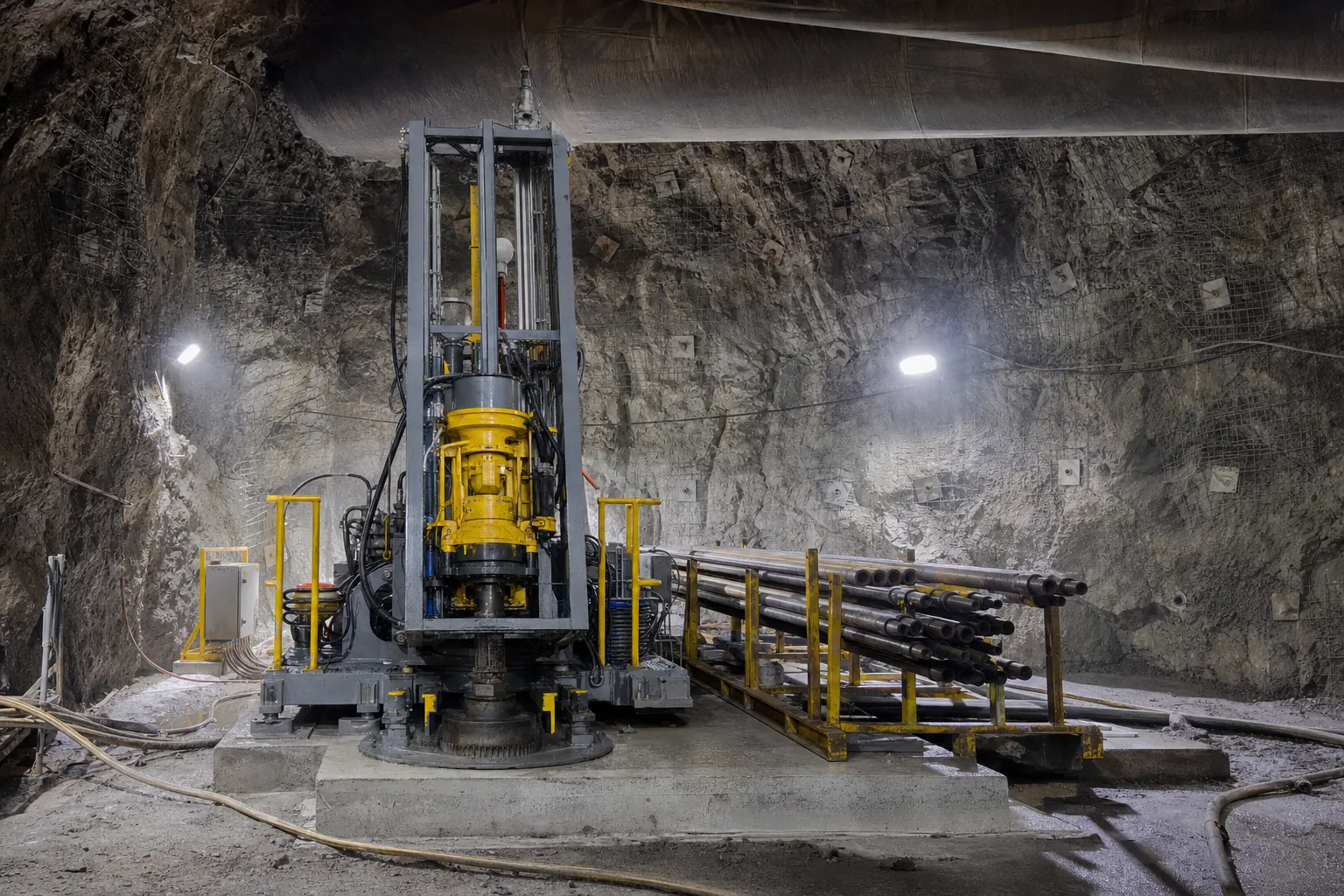
Raise boring programmes are usually drawn up around the rig, the ground and the production plan, with survey added wherever it seems to fit. A raise bore alignment survey has fixed places in that sequence, and moving any of them later costs more than it saves.
Quick Answer
Survey verification belongs at three points in a raise bore programme. Before the rig is set up, the two levels are checked against a common reference. After the pilot hole is drilled and before reaming starts, the pilot's path is measured, because a pilot hole cannot be corrected once drilled and the ream follows it. At breakthrough, the actual position is confirmed on the target level. The middle point is the one most often deferred, and it is the one that cannot be.
This article places those three points in the programme and explains what each one decides. It does not cover how a gyroscopic instrument works in general, which is in our article on what a gyro survey measures.
Where survey sits in a raise boring programme
Survey verification sits at three fixed points in a raise boring programme, and each point is tied to a decision that has to be made straight after it.
| Point in the programme | What is verified | The decision it informs |
|---|---|---|
| Before rig setup | Both levels against a common reference | Where the collar and the target are marked |
| After the pilot, before reaming | The path the pilot hole has taken | Ream, or stop and decide first |
| At breakthrough | The actual position on the target level | Accept and record the result |
A point that is skipped does not move to later in the sequence. Its decision is simply made without the information.
Key point
Each survey point is worth exactly the decision it informs. Measured after that decision is made, it becomes a record of what happened rather than a check.
Why the two levels are checked against each other first
The measurement that matters most before setup is not the collar position on its own, but the relationship between the two levels the hole will connect.
Each level can be correct within its own survey network and still be wrong relative to the other. That is why the check before setup verifies both levels against a common reference, rather than accepting each level's control at face value. At Harmony Doornkop, Survey House carried out check surveys between levels to confirm accurate raise bore holings for ventilation holes. Where the levels are connected through a shaft, the same reference often comes down through shaft survey work or through gyroscopic orientation.
Not sure your two levels agree?
Send us the level plans and control records. We will tell you what needs checking before setup.
Ask for a between-level checkThe pilot hole check, step by step
The pilot hole check is the point most often pushed later in the programme, and it is the one with the least room to move.
Measure before the reamer goes on
A pilot hole's path cannot be corrected once it is drilled. It can only be measured. The reaming pass then enlarges the hole along the path the pilot has already set, so reaming will not straighten a deviation. The check therefore belongs after the pilot and before reaming, while the result can still inform a decision.
Choose an instrument that suits the drill string
The pilot is drilled through a steel drill string, which can disturb a magnetic sensor's reading. Downhole deviation surveys are therefore commonly carried out with gyroscopic instruments. Some sites still use magnetic tools where the interference has been assessed as acceptable, and that assessment should be recorded.
Agree what the result will decide
Before the survey, agree who reads the result and what happens if it is not what the design expected. A result with no agreed next step can end up reamed anyway, which turns a checkpoint into a record.
Key point
The pilot hole check is the last moment the hole's path is still a decision. After reaming starts, it is a fact.
Confirming breakthrough on the target level
The final survey point confirms where the hole actually arrived, measured on the target level against the same reference used before setup.
This is what lets the mine plan the work that connects to the raise with known rather than assumed positions. The breakthrough record should state the reference used, the position found, and how it compares with the design. Underground, it then becomes part of the mine's survey record for that connection.
On a long programme, it also helps to plan survey attendance around the mine's access windows, as covered in our article on underground survey planning.
Planning a raise bore programme now?
Send us the hole details and the levels. We will place the survey points in your programme.
Get a raise bore survey quoteWhere survey cannot help you
Survey fixes the reference and verifies the result, but some outcomes of a raise boring programme sit outside what survey can control.
Survey does not steer the drill. Deviation during drilling is a function of the drilling operation and the ground. Survey cannot correct a pilot hole that has already deviated, and it cannot make a skipped check happen after the event. Background on how a raise boring machine works is widely available, for example in this overview of the raise borer.
What survey can do is give both levels a common reference, measure the pilot while the result still counts, and confirm breakthrough so the consequences are known.
Breakthrough not where the design expected?
An independent check can establish where the hole arrived, and why.
See survey auditsLet's Build With Accuracy.
Raise bore verification placed where each result can still inform the next decision.
Request a Quote No obligation — we reply within one business day.