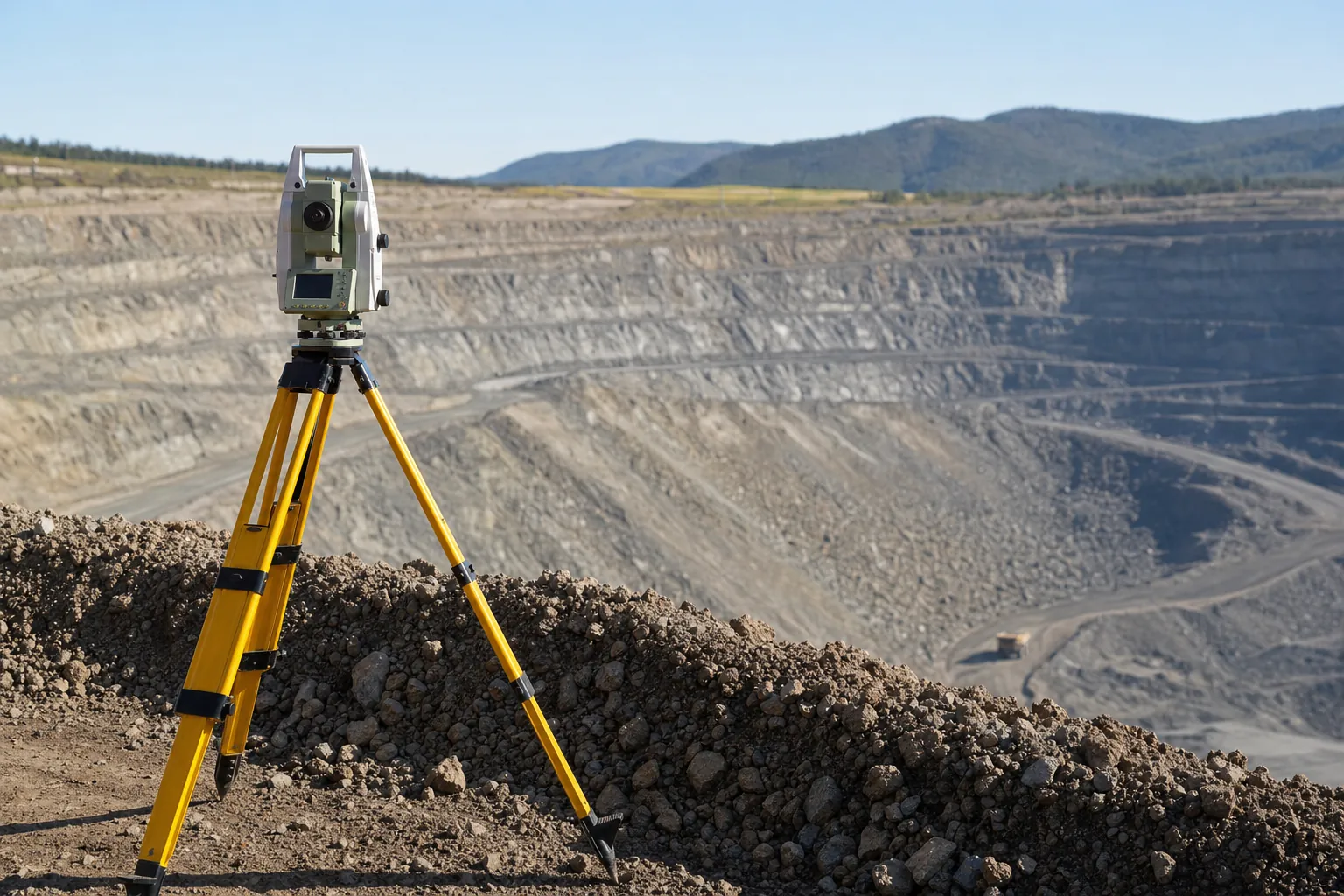
Open pit bench survey work has to happen where the pit is busiest. On opencast operations, the crew needs to reach ground that blasting and loading equipment also use, so the survey plan has to start from the production plan, not from the surveyor's diary.
Quick Answer
Split the survey into tasks that need the crew on or near the active bench and tasks that can be done from outside the exclusion zone. Schedule the first group around the blasting and mobile equipment schedule, confirmed with the operations team before every visit. Do the second group whenever suits. Even aerial capture from outside the zone needs confirmation that the zone is not active while it runs. Record what was done on each visit.
The same principle applies underground, where access windows set the pace. That setting is covered in our article on underground survey planning. This one is about the open pit.
Planning an open pit bench survey in three steps
An open pit bench survey runs safely and on time when the work is split by where the crew must stand, and each visit is confirmed against the production plan.
Step 1: split the tasks by location
List the tasks that need the crew on or near the active bench, such as picking up a crest or toe line close to the face. List separately the tasks that can be done from outside the exclusion zone, such as capture from a safe vantage point or from the air, and all computation and plotting. The aim is to keep the time the crew spends near active ground as short as the work allows.
Step 2: confirm the schedule before every visit
A bench survey requires the crew to occupy or approach ground that equipment and blasting also use. Confirm the blasting schedule and the mobile equipment schedule for the area with the operations team before each visit. Do not rely on last week's plan. Production plans change from shift to shift, and the plan that matters is the one for the day of the visit. Agree a fallback as well: if the area becomes active, which task moves to the next window and who decides.
Step 3: record what was done and what was not
Record what was surveyed, from where, and anything that could not be reached on the day. That record tells the planning team which figures are current and which areas need another visit. Over a few months, it also shows whether one area is repeatedly missed, which is usually a scheduling problem worth raising with operations.
Underground, the same split between work at the face and work elsewhere applies. An open pit bench survey differs mainly in scale: the exclusion zones are larger, the equipment is bigger, and more of the work can be done from a safe distance.
Key point
Put the crew near the active bench only for the tasks that need it, and only after the schedule has been confirmed for that visit.
Bench surveys clashing with production?
Tell us your blasting and loading cycle. We will draft a visit plan around it.
Ask for a bench visit planWhat to confirm, and with whom
Most lost or unsafe visits trace back to something assumed rather than confirmed, so name what is confirmed and who confirms it.
| Confirm before the visit | Why |
|---|---|
| The blasting schedule for the area | The crew must not be near a bench being prepared for a blast |
| The mobile equipment schedule | Loading and hauling share the same ground |
| The exclusion zone boundary | Remote capture still needs the zone inactive |
| A named contact on the shift | Questions on the day reach someone who can answer |
One named person in the operations team should confirm each visit. That person should also be told when the crew leaves the area, so the zone can be released for equipment without waiting. A short call before and after each visit is usually enough, and it keeps the survey crew and the production team working from the same picture of the bench.
The mine's own safety procedures govern entry to the pit, and the Mine Health and Safety Council is a useful starting point for the wider framework those procedures sit in.
Aerial capture can reduce the time the crew spends near active ground. It does not remove the need to confirm the schedule, because the exclusion zone must still be inactive while the aerial survey runs.
Key point
Confirm the blasting and equipment schedule with one named person before every open pit bench survey visit, including visits that use aerial capture.
Starting regular pit surveys?
Send us the pit layout and the reporting cycle. We will price a repeatable plan.
Get an opencast survey quoteWhere survey cannot help you
Good planning keeps bench surveys safe and on time, but some constraints sit outside what any survey plan can change.
A survey plan cannot make an active bench accessible, and it cannot replace the mine's own decision on who enters the pit and when. It cannot capture ground that was not reached, and it cannot keep a figure current once mining moves on. What it can do is fit around production, record what was done, and hand over figures with the date and extent that the planning team needs, as covered in our article on the opencast survey handover. Monthly volumetric surveys and stockpile surveys on the same site benefit from the same schedule.
Pit figures that do not match the plan?
An independent check can establish which survey each figure came from.
See survey auditsLet's Build With Accuracy.
Bench surveys planned around your blasting and loading cycle, with every visit confirmed first.
Request a Quote No obligation — we reply within one business day.