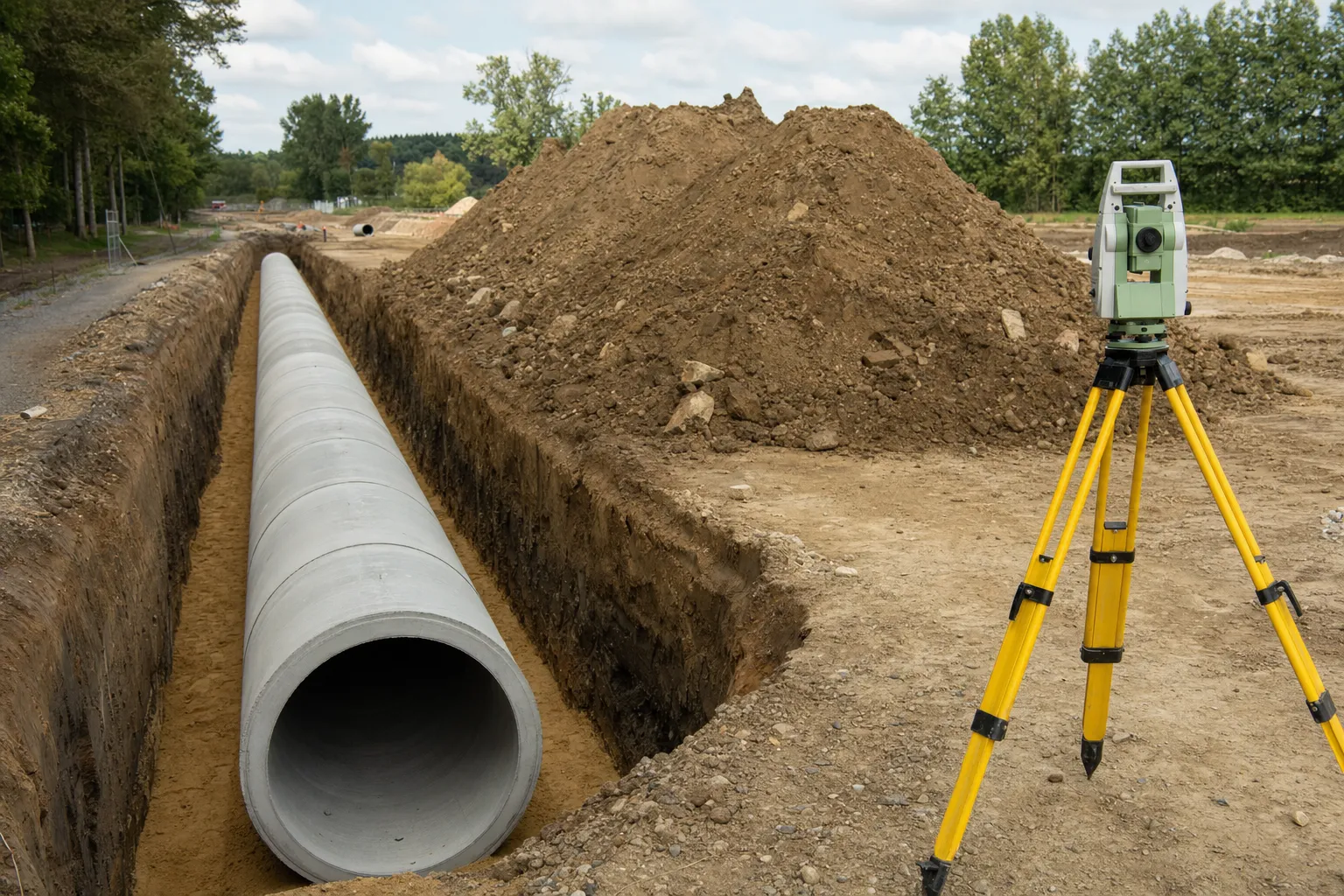
As-built survey timing is usually decided by the backfill programme, not by the surveyor. On as-built surveys, the window to measure buried or concealed work closes the moment it is covered, and after that its position can only be recovered at extra cost, if at all.
Quick Answer
Work that will be covered, such as a backfilled trench, encased pipework, a concealed connection or cladding over structure, cannot be measured again once covered. Survey it in the window between completion and cover. A survey of the finished surface cannot reliably reconstruct what is beneath it. Build survey hold points into the programme so nothing is covered before it is measured.
What should arrive at the end of any survey is covered in our survey handover checklist. This article is about the timing that makes an as-built record possible.
Which work must be surveyed before cover
Any element that becomes physically inaccessible once covered has to be surveyed in the window between being completed and being covered, because that window does not reopen.
| Work type | What to capture before cover | Why it cannot wait |
|---|---|---|
| Pipe in a trench | Inverts, line, joints, fittings | Backfill hides the pipe |
| Encased pipework or ducts | Position and level of each run | Concrete encasement hides it |
| Concealed structural connections | Position of the connection | Cladding or finishes hide it |
| Services crossing other services | Both services at the crossing | Backfill hides the clearance |
| Foundations before backfill | Footing positions and levels | Fill hides the footing |
The finished surface does not show what is below
Once covered, a survey of the surface can show the surface. It cannot reliably show the pipe or connection underneath, unless something still marks it at the surface, such as a chamber cover or an access point. Recovering a covered element then needs exposure, by digging, or a non-destructive locating method such as ground-penetrating radar and utility detection. Both cost more and may be less certain than a measurement taken before cover.
Key point
Buried and concealed work has one chance to be surveyed directly: after completion and before cover.
Backfill due this week?
Tell us what is going into the ground. We will say what must be surveyed first.
Ask us what to captureScheduling the as-built survey
The survey is quick to do but easy to miss, so the answer is to make it a hold point in the programme rather than a task someone remembers on the day.
Make it a hold point
Write survey hold points into the programme: no backfill, encasement or cladding until the as-built survey of that section is done and recorded. Name who releases each hold point. On civil construction surveys, this is often the site engineer.
Give the surveyor notice
The survey can only happen in the window, so the surveyor needs to know when the window opens. Agree how much notice the site will give and how the call is made. A crew arriving after the trench is backfilled has nothing to measure.
Survey in sections
On long trenches and large slabs, work progresses in sections. Survey each section as it is completed, rather than waiting for the whole job. That keeps the backfill moving and gives a record of each section on the day it was laid.
Tie to the same control as the design
The as-built survey must be tied to the same control and coordinate system as the design and the setting out, as on construction setting out. Otherwise it cannot be compared with the design or used to locate the work later.
Record what was captured
For each section, record the date, the elements measured, the control used and anything that could not be reached, such as a joint already under water or a fitting hidden by shoring. Keep a photograph of the open work with the record where possible. That short note tells the next person which parts of the record were measured and which were not, so nobody later relies on a position that was assumed. Where the design changes after a section is laid, survey the change against the same control and date it, so the record shows which version is actually in the ground.
Drawings and surveys are different records
A contractor's marked-up drawing records what the site team believes was built. An as-built survey independently measures what was built. The two can disagree, because a mark-up records a belief, not a check. Where the record matters, for future excavation, maintenance or a handover, ask which one you are being given. Both have a place. A mark-up is quick and shows intent; a measured record shows position. For anything that will be dug up, connected to or built over later, the measured record is the one to keep.
Where survey cannot help you
A survey taken before cover gives a reliable record, but some limits sit outside what any survey can do once the moment has passed.
A survey cannot see through backfill or concrete. It cannot recover the position of work that was covered before it was measured without exposure or locating methods. And it cannot guarantee that the record is kept and passed on. The South African Institution of Civil Engineering is a useful starting point for the construction framework most civil projects use.
Key point
Make every as-built survey of buried work a hold point, give the surveyor notice, and tie it to the design control.
Need as-built records for buried services?
Send us the programme. We will plan the survey hold points around it.
Get an as-built survey quoteWork already covered without a record?
See how buried services can be located without excavation.
See utility detectionLet's Build With Accuracy.
As-built records taken before cover, tied to the same control as your design.
Request a Quote No obligation — we reply within one business day.