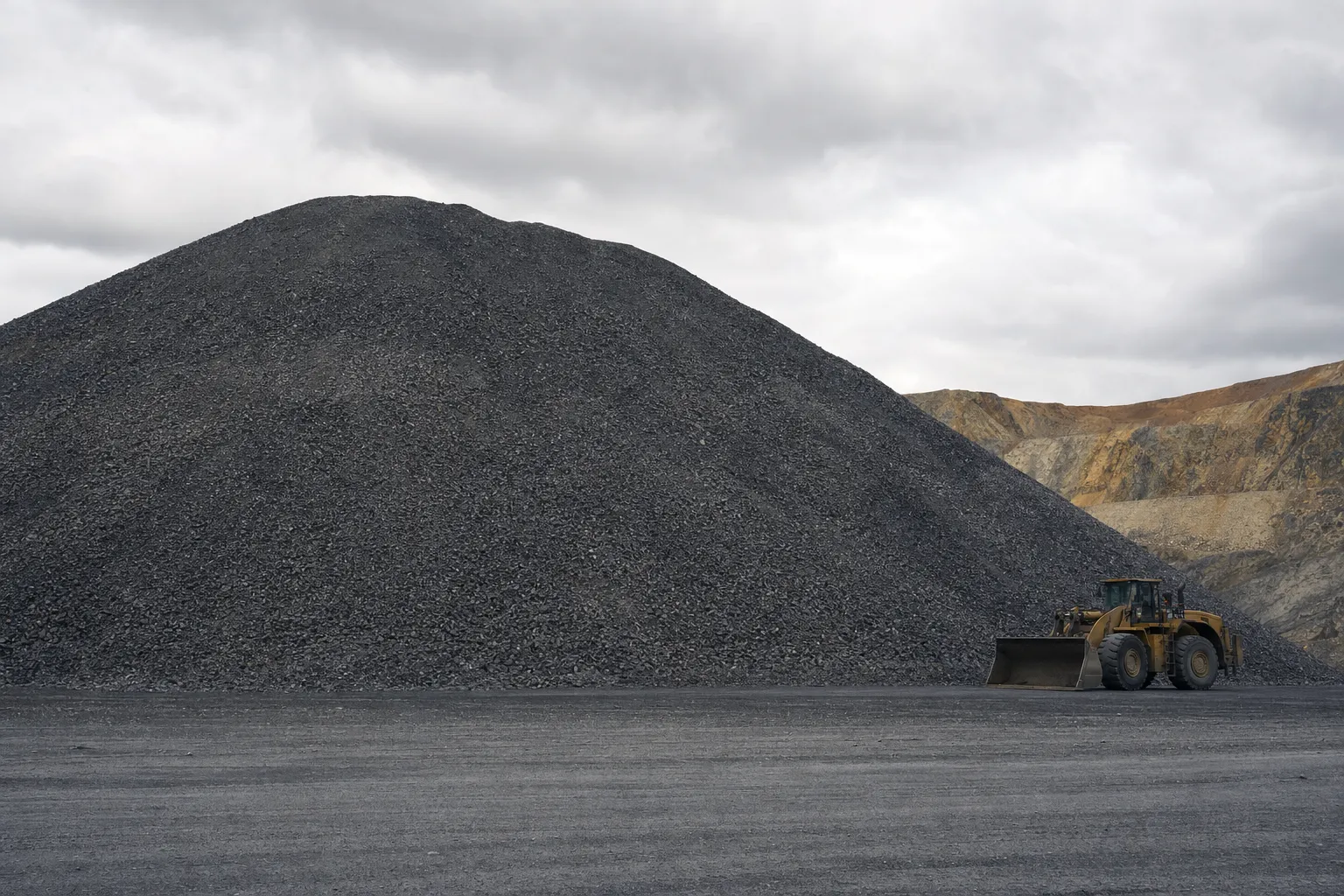
Stockpile survey work rarely happens on a quiet pad. On stockpile surveys at a working mine or quarry, loaders and stackers keep moving material while the crew or drone captures the pile, and that movement can quietly change the volume.
Quick Answer
The survey models the pile as it was during the capture window. Material added, removed or pushed during that window is not represented consistently, and it can distort the volume. Agree a short window with operations: one quick pass, a pause on the pile or section being measured, and a written record of anything that moved and when. Agree it before capture, not on the day.
Keeping repeat surveys comparable from month to month is covered in our article on stockpile volume measurement. This article is about a single capture.
Why movement during capture matters
A survey builds the surface of the pile from many observations taken over a period of time, and it assumes the pile stayed the same while they were taken.
Whether the capture is by drone, by laser scanner or by a crew with a rover, it takes time. If a loader takes a bucket from the toe halfway through, part of the surface shows the pile before and part after. If a stacker adds material to the crest, one side may show it and another not. The model does not know which observations came first. It joins them into one surface that may never have existed on the ground.
The effect is reduced, not removed
A faster capture helps. One short, single pass over the pile leaves less time for change. But a short pass is not a guarantee. Any movement during it still affects the result, so the best answer is a pause on the part being measured, plus a record of anything that did move.
Key point
A survey assumes the pile stood still. Plan the capture so that it did, or record where it did not.
Loaders working every time the crew arrives?
Tell us your loading schedule. We will plan a capture window around it.
Ask us to plan the windowPlanning the stockpile survey window
A short checklist, agreed with operations before the visit, turns a static pile from a hope into an arrangement.
| Agree before capture | What it prevents |
|---|---|
| The time of the capture window | Arriving during peak loading |
| Which pile or section pauses | Movement on the part being measured |
| A single, short capture pass | Long exposure to change |
| A named contact on the shift | Nobody to call when plans change |
| A record of any movement | A volume nobody can interpret |
Pause the part being measured
Often the whole operation does not need to stop. A pause on one pile, or on one section of a large pile, for the length of one pass may be enough. Agree which section, for how long, and who confirms it is clear. Shift changes and planned breaks are often natural windows.
Confirm the window on the day
Plans change from shift to shift. Call the named contact before the crew or drone starts, and confirm that the pile is still paused. Agree what happens if it is not: wait, move to another pile first, or capture and record the movement. Then tell the contact when capture is finished, so the loader can return to work without waiting longer than it needs to.
Fit the method to the window
The length of the window affects the choice of method. A short window favours a method that covers the whole pile quickly in one pass. A longer window, or a small pile, gives more freedom. Where piles sit against walls or other piles, the method also has to see the toe and the faces, which may take longer. Agree the method and the window together, so one does not undo the other. Whichever method is used, keep it the same from month to month, because figures from different methods are harder to compare.
Record what moved
If material moved during capture, write it down: which part of the pile, roughly when, and what kind of movement, such as loading, reclaim or dozing. That note travels with the figure. When the volume is later compared with production records, as covered in our article on stockpile reconciliation, the note explains part of any difference before anyone questions the measurement.
Safety comes first
Crews and equipment share the pad. The mine's own procedures govern access, and the Mine Health and Safety Council is a useful starting point for the wider framework. Capture from outside the operating area, for example by aerial survey, reduces exposure, but the pile still needs to be still while it is captured.
Where survey cannot help you
A well-planned window gives a volume that describes one moment, but some questions sit outside what any single capture can answer.
A survey cannot reconstruct what a moving pile looked like at an instant nobody captured. It cannot measure material that was loaded out before capture, and it cannot give tonnes without a density from sampling. Where piles feed volumetric reporting each month, keep the same window, method and extent each time, so the figures can be compared.
Key point
Agree the window, the paused section and the record before every stockpile survey visit.
Need monthly stockpile figures?
Send us the piles and the loading pattern. We will price a repeatable plan.
Get a stockpile survey quoteStockpile figures that do not reconcile?
An independent check can test each figure against its stated basis.
See survey auditsLet's Build With Accuracy.
Stockpile volumes captured in an agreed window, with any movement recorded.
Request a Quote No obligation — we reply within one business day.