Shaft equipping survey work decides whether steel made in a workshop fits a shaft it has never seen. The shaft sinking and equipping survey sets the references every equipping trade builds from, and the cheapest time to agree them is before fabrication starts.
Quick Answer
Before the equipping contractor designs or fabricates anything, agree four things: which survey control network every party will set out from, which reference lines and levels the steelwork is designed to, when each reference will be issued in the programme, and how each stage of installation will be verified. Where steel is already in the shaft, measure it first. References agreed after fabrication can only be checked against, not designed to.
The question usually arrives early, when the equipping contractor asks for reference lines before design is even finished. That request is a good sign. It is also the moment to agree what those references are and who owns them.
What a shaft equipping survey must settle first
A shaft equipping survey must settle one shared control network, the references built from it, and the programme dates when each reference is needed.
| Item to agree | Why it matters |
|---|---|
| One control network for every party | Independent control is not guaranteed to agree |
| The reference lines and levels steelwork is designed to | Steel is built to the references it is given |
| When each reference is issued | Late references can only be checked, not designed to |
| How each stage is verified, and to what depth | A check covers only the stage reached when it was taken |
| Who records changes to the references | Everyone must work to the current issue |
One network, not several
Where several contractors work in the same shaft, their setting-out should all trace back to the same survey control network. Control established independently by different contractors is not guaranteed to agree, even when each set is internally consistent. The brief should name the network and its owner. Where the mine already has a shaft control network, use it rather than creating a new one.
References before fabrication
Equipping steel is designed and made to the lines and levels it is given. Agree those references while the design can still respond to them. Survey House has carried out steady bracket and tape bracket installation surveys, and has provided shaft equipping oversight on behalf of clients. In each case, the references came first.
Key point
Agree the control network and the references before the workshop starts cutting steel. After that point, survey can confirm the fit but cannot design it.
Verification follows the programme, stage by stage
A verification survey in a shaft confirms alignment or position only to the depth or stage reached at the time it was taken.
Work carried out after that check is not covered by it and needs its own verification. Equipping is progressive, so the verification plan should be too. Name the stages, the depth each check covers, and who receives each result. A report that says "the shaft was verified" without a depth or stage tells the reader very little.
A shaft equipping survey plan that lists the stages in advance also helps the equipping contractor, who can schedule installation around the checks rather than wait for them. Agree who gives notice that a stage is ready, and how quickly the check follows.
The connection between surface and underground control also needs its own plan. That subject is covered in our article on shaft survey control.
Equipping contractor asking for references?
Send us the programme and the design stage. We will list what to agree first.
Ask us what to agreeWhen steel is already in the shaft
On a restarted or extended project, the new work has to connect to steel that is already installed, so that steel must be measured before anything new is designed.
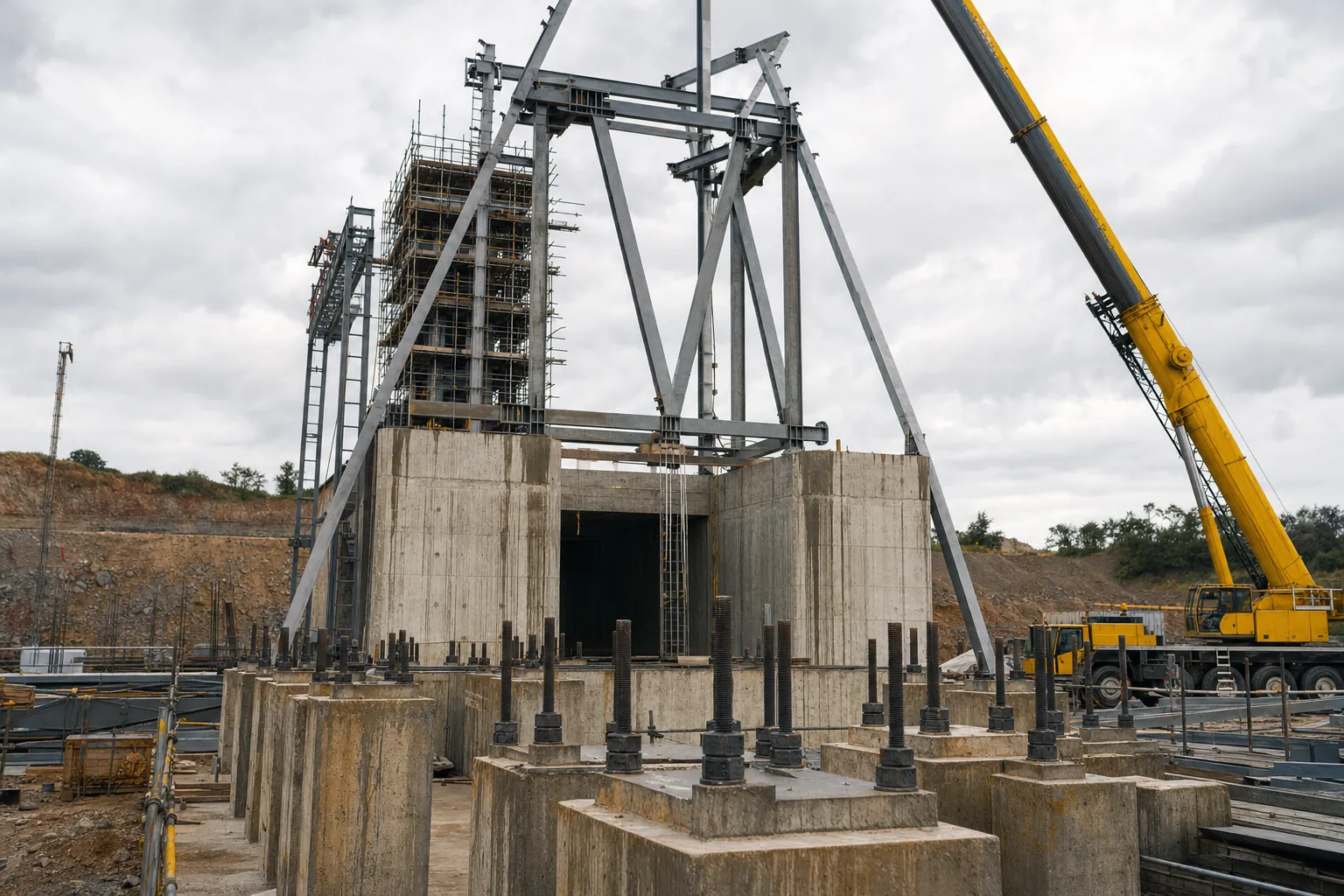
The Mindola shaft project for Mopani Copper Mines in Zambia is a recent example. Work stopped when Covid struck in 2020, with the shaft partially equipped. When the project was awarded to Cementation Zambia to restart and complete, every piece of historic surface survey infrastructure had been lost. Survey House re-established the surface network, re-surveyed the existing shaft wires, and scanned the upper portion of the shaft. The purpose was specific: to make sure the new permanent headframe would tie up with the steel structures already in the shaft.
Measure what is there
Drawings from before a stoppage show what was intended. A survey or a 3D laser scan shows what is actually installed. Design the connecting steel to the second, not the first.
Re-establish direction independently
Where surface control has been lost, direction can be re-established independently by gyroscopic observation, then tied into the new network before any reference is issued.
Key point
On a restart, design to measured steel, not to old drawings. The scan or survey costs less than a headframe that does not meet the shaft.
Restarting a partly equipped shaft?
Tell us what was installed and what is planned. We will scope the survey and scan.
Get a shaft survey quoteWhere survey cannot help you
A well-planned shaft equipping survey keeps every trade on one reference, but some risks in equipping sit outside what survey can control.
Survey does not fabricate the steel or install it. It cannot make a late reference early, and it cannot verify work that was installed after the last check. It cannot decide, on the project's behalf, what to do when installed steel and design disagree. What it can do is issue one set of references, verify each stage, and report what was found plainly. The Southern African Institute of Mining and Metallurgy is a useful source for the wider engineering practice equipping sits within, and an independent check can test a stage when a result is in doubt.
Need a stage checked independently?
An independent check reports what was verified, and to what depth.
See survey auditsLet's Build With Accuracy.
Shaft equipping references agreed before fabrication, and verified stage by stage.
Request a Quote No obligation — we reply within one business day.