
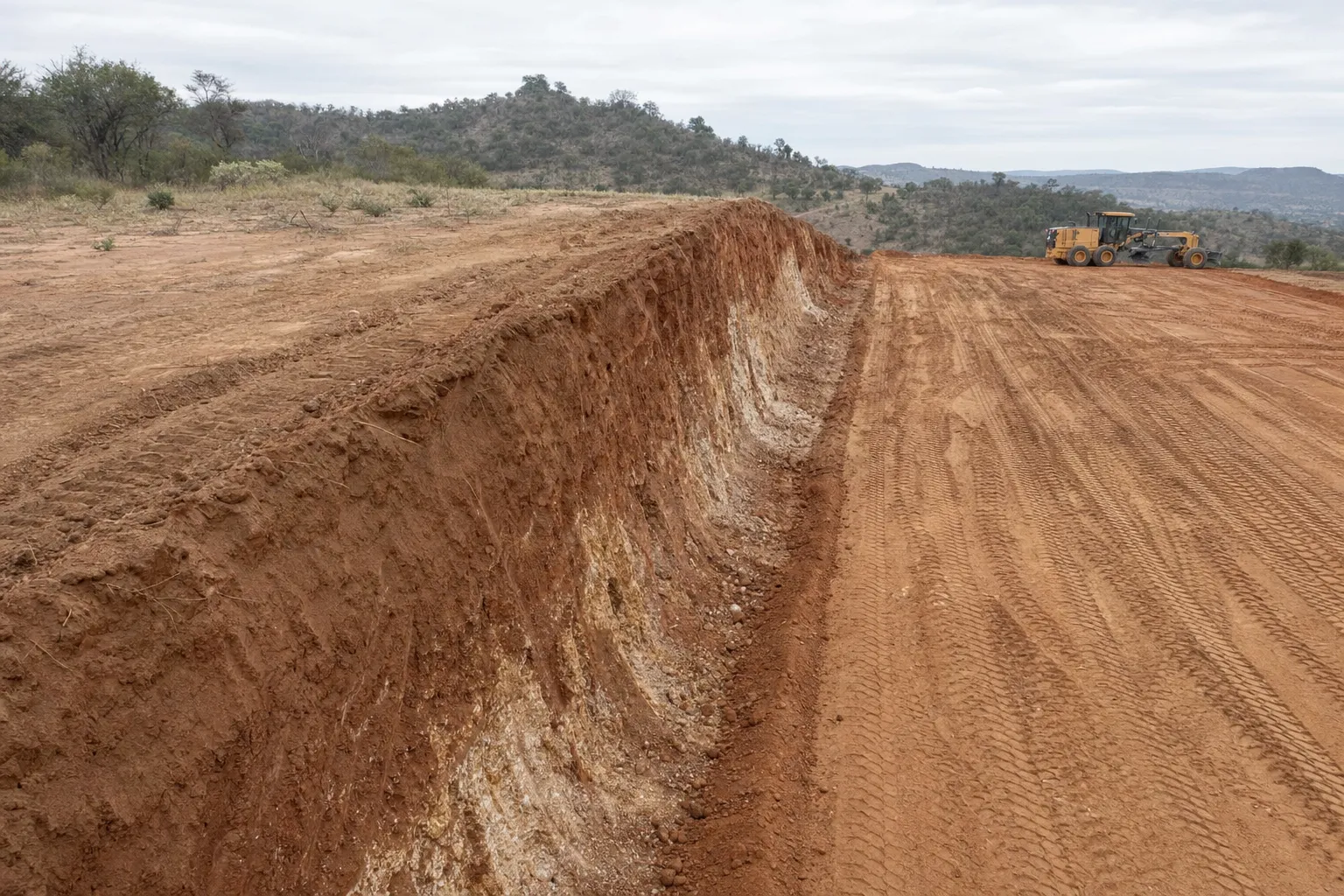
Cut and fill figures answer a question that the net volume alone cannot: how much material actually moved. On volumetric surveys, a small net total is often read as a small job, when in fact two large movements have nearly cancelled out.
Quick Answer
Net volume is cut minus fill. Where cut and fill happen in the same reported area, they offset each other, so the net can be small even when both are large. Report cut, fill and net together, never the net alone. State which two surfaces were compared and the area each figure covers, because a volume calculation depends on the surfaces used, not only on the site.
Converting a volume into tonnes is a separate step. Our article on survey volume and tonnage covers that. This article is about the volume itself.
How cut and fill relate to the net
Every earthworks volume is a comparison between two surfaces, and the cut, the fill and the net are three different ways of describing the difference between them.
Where the later surface is below the earlier one, material has been removed: that is cut. Where it is above, material has been placed: that is fill. The net is the cut minus the fill across the whole reported area. On a platform where one side was cut down and the material was pushed across to build up the other side, the cut and the fill can both be large and the net close to nothing.
| Figure | What it shows | What it hides |
|---|---|---|
| Cut | Material removed | Where it went |
| Fill | Material placed | Where it came from |
| Net | The balance | How much moved in total |
Why the net alone misleads
A net figure on its own invites the wrong conclusion. A client may read a small net as little work done. A planner may read it as little material to import or remove. Both can be wrong. The plant hours, the haul and the compaction were spent on the gross movements, not on the balance.
The same applies when a figure is passed on. A net total copied into a progress report or a board summary loses the context it came with. By the time someone reads it, nobody remembers that the platform was balanced on purpose. Keeping the three figures together in every report, and in every summary taken from it, stops that loss of context before it starts.
Key point
A small net volume does not mean little material moved. Ask for cut and fill as separate figures beside the net.
A net figure that does not match the work?
Send us the report. We will show the cut and fill behind it.
Ask us to review the volumesWhich surfaces the figures compare
A cut and fill result depends on which two surfaces are compared, not only on the site that was measured, which is why the surfaces must be named in every report.
The same site can produce different totals against original ground, against an earlier survey or against the design surface. Each comparison answers a different question. Against original ground, the figures show the work done since the start. Against last month's survey, they show the work done this month. Against the design, they show what is still to be done. None of these is wrong, but they cannot be compared with each other.
Name the area as well
State the boundary each figure covers. A report that splits the site into zones may show cut in one zone and fill in another, with a small net for the site as a whole. That split is useful, because it shows where material came from and went to. On mines, the same reasoning applies on opencast mining surveys and to pads beside stockpile surveys.
What to ask for in an earthworks report
A short list, agreed before the first survey, makes every later cut and fill report readable without a follow-up question.
Ask for cut, fill and net, reported together. Ask for the two surfaces compared, by name and by date. Ask for the boundary of each area reported. And ask for the capture method, whether ground survey or aerial survey, so a change in method is visible when figures are compared over time. Where the volumes feed a payment, the measurement basis belongs in the contract. South African civil contracts often refer to the SANS 1200 series, and the South African Institution of Civil Engineering is a useful starting point for that framework. Agree the basis before anyone calculates a figure.
Key point
Every cut and fill report should name its two surfaces, its dates and its boundary. Without those, two reports cannot be compared.
Need monthly earthworks figures?
Tell us the site and the reporting cycle. We will report cut, fill and net each time.
Get a volumetric survey quoteWhere survey cannot help you
Clear reporting makes earthworks figures hard to misread, but some questions sit outside what a volume calculation can answer.
A survey cannot say where material went after it left the site, or which load came from which cut, unless that movement was recorded separately. It cannot recover a surface that was never surveyed, so if original ground was not captured before work started, every later figure has to be compared against something else, and that should be stated. And it cannot choose the payment basis, which belongs to the contract. Our article on survey acceptance criteria covers what to agree before the work begins.
Two volume reports that disagree?
An independent check can establish which surfaces each report compared.
See survey auditsLet's Build With Accuracy.
Earthworks volumes reported as cut, fill and net, with the surfaces and boundaries stated every time.
Request a Quote No obligation — we reply within one business day.